


12-05-2025 VaYishlach
שאלו שלום ירושלים
Pray for the peace of Jerusalem
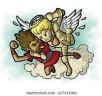
You will find this week’s parashah, called VaYishlach meaning:“ He sent forth” in the Book of Genesis: 32:4-36:43. The week’s section revolves around Jacob’s maturation and spiritual growth. Perhaps the section’s most famous tale is that of the battle between Jacob and what is called in Hebrew “the Ish.” The Hebrew word “ish” is a complex word meaning: “a divine being” or “another person”, or even “oneself”. Thus, the text’s ambiguity leaves us in an intellectual quandary. Is the text’s lack of clarity meant to force us to wrestle with its meaning just as Jacob had to wrestle with the ish?
This tale also presents us, for the second time, the idea that Jacob seems to have a habit of “holding onto or grabbing onto” another being. We note that Jacob facilitated his birth by holding onto Esau’s heal, now he wrestles with the “ish” and refuses to let go until he receives the ish’s blessing. (32:27). What is the text teaching us by this holding on, by this wrestling match? Is the text teaching us that Jacob has finally come to realize that he must take responsibility for his past and future actions? Is it teaching us, that creativity cannot be taken from another but rather we must first find out who we are by looking deep into our own souls?
This text reminds us that each of us must find our own way, that no of us can continually hold onto another. Until what point do we trust in another and to what point do we trust only in ourselves?
Reviewing Jacob’s life, we see a man who begins life as a schemer. Now as he prepares himself to re encounter his brother by crossing the River Yabbuk, both physically and spiritually, we meet a man who has come to realize that in life cleverness is not enough, that he must find meaning and commitment in his own life if he is to succeed. Jacob must grapple with the fact that humans must balance their need for the tangible with their need for the spiritual. Does Jacob’s wrestling with the “ish” represent this realization? Has he come to understand that we all need balance between the daily actions of life and the eternal spiritual side of life?
In this week’s parashah we note that in life’s struggles between the sense of self-knowledge and the knowledge of the other, that Jacob comes to realize to find G-d one must seek G-d. Might this new insight be the reason behind his name change from Jacob (holding on to the other) to Israel (struggling with the Divine)?
From this point until the end of the Hebrew Bible two themes will be ever present, the theme of the “I” in contrast to the “we” and the question of how do we resolve the struggle between our sense of self and our sense of the other, between the tangible and the spiritual? How do we struggle to answer these questions? What do your answers tell you about who you are?
YouTubes for the week
Getting in a Chanukkah Mood
Era-lution
The Latke song
Canciones de Janucá en español
Please pray for Israel’s soldiers and the safe return of all of the remaining hostages.